Operations Wing
Consists of five sections:
Operations Bureau
Comprises the Operations Division, the Railway Division, and the Police Tactical Unit Operational Contingents. Its main responsibilities include operating the Headquarters Command and Control Centre on a 24/7 basis and handling operational matters such as formulating relevant Force orders, overseeing boundary security, devising railway policing policies, allocating operational resources, liaising with the Hong Kong Garrison and foreign military and implementing the Government-led ‘Territory-wide CCTV Installation Scheme’.
Police Tactical Unit
Police Tactical Unit (‘PTU’) Headquarters includes Training Division, Support Division and Research and Development Division. Its main duty is to provide training on internal security and ensure the Force’s readiness to respond to any threat to public order or internal security. The PTU companies also provide Police Regions with readily available reserves of well trained and fully equipped manpower for any routine or emergency duty. PTU also continually reviews tactics and equipment used in crowd management and public disorder, to ensure both are relevant and develop with prevailing circumstances and threats.
Explosive Ordnance Disposal Bureau
Is responsible for dealing with all illegal explosive objects (other than small arms ammunition) including Chemical, Biological, Radiological and Nuclear (CBRN) Weapons in Hong Kong. The Bureau is trained and equipped to deal with items both on dry land and underwater and is called out, on average, over one to two times per week. Items dealt with range from illegal fireworks, improvised explosive devices (home made bombs) to large World War II aircraft bombs.
Major Events Bureau
The Major Events Bureau oversees the Force's overall strategy and specific policies on the planning, co-ordination and liaison of operations relating to the policing of significant Public Order Events and major events. The Bureau comprises three divisions, namely the Major Events Planning Division, Police Public Engagement Office and Key Points and Search Division.
Counter Terrorism and Major Incidents Bureau
The Counter Terrorism and Major Incidents Bureau, comprising the Counter Terrorism and Major Incidents Division, Counter Terrorism Response and Exercise Division and the Special Duties Unit, has been established since June 2024 to enhance the overall counter-terrorism capabilities of the Force. The Bureau is mainly responsible for formulating, implementing and reviewing the Force's policies and orders relating to counter-terrorism and major incidents; strategically deploying the Counter Terrorism Response Unit and the Special Duties Unit; as well as conducting and coordinating Forcewide and cross-regional counter-terrorism and other thematic exercises.
Police Regions
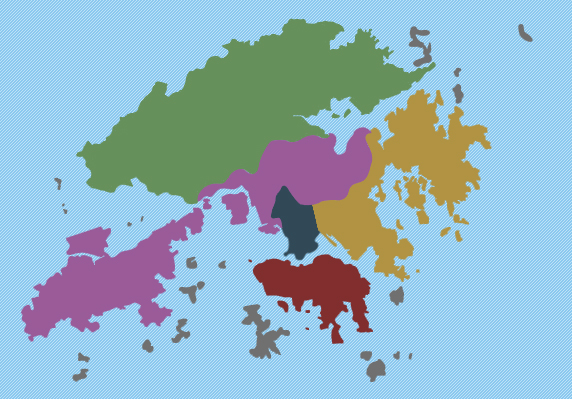
The Force is divided into six regions:
 Hong Kong Island,
  Kowloon West,
  Kowloon East
 New
Territories North,
New
Territories North,  New
Territories South, and
New
Territories South, and 
 Marine.
The regions are divided into 23 districts and divisions and in a few cases, sub-divisions. Regional police provide front-line policing 24 hours a day. They are responsible for the traditional constabulary functions of preserving life and property; preventing and detecting crime; keeping the peace; and responding in times of emergency.
Land Regions
Each of the five land regions has a headquarters comprising:
Operations Formation responsible for dealing with operational matters and procedures at Regional level. It is broken down into:
-
Regional Command and Control Centre (RCCC) - provides the means for exercising control over resources both at regional and district levels. It also acts as an information centre for the passage of information to the Headquarters CCC and other agencies. Equipped with the Third Generation Computer Assisted Command and Control System, each Centre receives 999 calls from the public and provides a fast and efficient service to operational officers.
-
Emergency Unit (EU) - provides a quick response to emergency situations, including 999 calls, as well as a speedy and additional presence of uniformed police on the ground to combat crime. An EU comprises a headquarters element and four platoons which operate on a three-shift basis.
-
Police Tactical Unit (PTU) - The Regional PTU Company provides a ready reserve to deal with threats to internal security situations and natural disasters. On a daily, non-emergency basis, the PTU is deployed on front-line street patrols to supplement District resources to tackle crimes.
Administration Formation implements policies laid down by the Regional Commander and is responsible for the Region's general administration. Its responsibilities include community relations, staff relations, and magistracies.
Crime Formation investigates serious and inter-district crimes. In addition, it collects, collates and evaluates intelligence on criminals and criminal activity within the Region.
Traffic Formation is responsible for:
- traffic control;
- enforcement of traffic legislation and regulations;
- investigation of traffic accidents;
- promotion of road safety; and
- implementation of Force and Regional traffic policies.
Marine Region
The Marine Police maintain the integrity of the sea boundaries and regional waters of the Hong Kong Special Administrative Region (HKSAR). It is responsible for:
- enforcing the laws of HK in regional waters;
- preventing smuggling and illegal immigration by sea;
- search and rescue in HK and adjacent waters.
The Marine Region comprises a Regional Headquarters and two Districts. With a fleet of 119 craft - 58 launches, 55 vessels, 4 barge operating platforms and 2 logistics barges, the Region polices 1,651 square kilometres (sq kms) of Hong Kong waters and 261 outlying islands. The Regional Headquarters comprises:
Operations Bureau which is responsible for all operational matters at Regional level, including:
- Regional Crime Units investigating crimes and syndicated illegal immigration and smuggling activities by sea;
- RCCC;
- Logistics Unit;
- Small Boat Division.
Administration Bureau which is responsible for general administration, management of regional finance, establishment and staff relations matters.
Support Bureau is responsible for:
- management of the launch acquisition programmes;
- training and assessment of Marine police personnel in navigation, seamanship, engineering and safety; and
- selection and acquisition of specialist equipment.
For more information, please click here.
Support Wing
Consists of two groups:
Support Branch
Support Bureau is divided into four divisions:
-
Field Division - is responsible for liaising and coordinating with other Government bureaux/departments on different policy areas, including animals, street management, missing persons and columbaria etc., and providing police assistance at appropriate levels. It also devises internal policy on and ensures compliance with the Personal Data (Privacy) Ordinance, Code on Access to Information, Sex Discrimination Ordinance, Disability Discrimination Ordinance, Family Status Discrimination Ordinance and Race Discrimination Ordinance, and coordinates Force response to such matters. The Division also handles routine correspondence and enquiries from other Government bureaux/departments and statutory bodies, such as the Legislative Council Secretariat.
-
General Division - is responsible for coordinating and formulating policies relating to arrest, station and branch routine, summonses and prosecution, police notebooks, property, funerals, delegation of authority, hire of police, bail, management of safes and other miscellaneous frontline operations. It also handles civil litigation against the Commissioner of Police, oversees station security of police premises and supervises the operation of the telephone recording system for all police report rooms. The Division is also responsible for the security and management of the Police Headquarters complex. Externally, it liaises with other departments in formulating police arrangements for public events such as elections.
-
Operations Support & Occupational Safety and Health Division - is responsible for coordinating and formulating policies relating to operational support, which includes use of force, arms and ammunition, uniform, accoutrements and equipment. The Division also oversees the Force occupational safety and health policy, manages the Force Safety Management System (FSMS) and promotes workplace safety awareness in the Force.
-
Police Licensing Office - acts as the licensing authority for a number of licences and permits, including Security Personnel Permits, Arms Licences, Temporary Liquor Licences and Societies Registrations etc., and policy matters relating to public order events.
Auxiliary Support Bureau:
Auxiliary Support Bureau provides a one-stop service in respect of the administration, personnel management and training of the Hong Kong Auxiliary Police Force with 3000 members. The Bureau comprises:
-
Administration and Support Section
-
Personnel Management Section
-
Training Section
Traffic Branch Headquarters
is responsible for the formulation and dissemination of traffic enforcement policies, the collation of related resource requirements, the processing of traffic summons and fixed penalty tickets, the monitoring of changes in traffic legislation, the development and evaluation of traffic management schemes, the management of the Force vehicle fleet and controls vehicle allocation, and the co-ordination of the Force's road safety efforts. It is also responsible for the administration of the Traffic Warden Corps, who assist the Police in the control of traffic and enforcement of parking offences. It comprises:
- Administration Bureau
- Administration Division
- Law Revision and Projects Division
- Transport Division
- Traffic Management and Prosecution Bureau
- Traffic Management Division
- Central Traffic Prosecutions Division
Public Relations Wing
is responsible for maintaining a high level of public confidence by robustly projecting a positive image of the Force through community and media relations. It is divided into three bureaus:
-
Community Relations Bureau
-
Information and Publicity Bureau
-
Media Liaison and Communication Bureau