Evaluating the latest canine recruit intake
The Police Dog Unit (PDU) is exploring a new
source of canine recruits and new methods of training handlers and dogs.
Since its formation in 1949, the PDU has largely followed the British
methods of training and usually recruited Alsatian dogs (German Shepherds)
for patrol work, Labradors and Springer Spaniels for sniffer duties, and
both breeds for search and rescue operations. Earlier, however, two
officers attended the Dutch Police Dog Unit's training sessions with the
Malinois breed that they favour. They told OffBeat about their
experiences.
PDU Senior Inspector, Mr Mike Ng Kwok-wing, and Sergeant, Mr Chan
Wai-ki, spent three and two months, respectively, in the Netherlands -
partly in their own time and at their own expense.
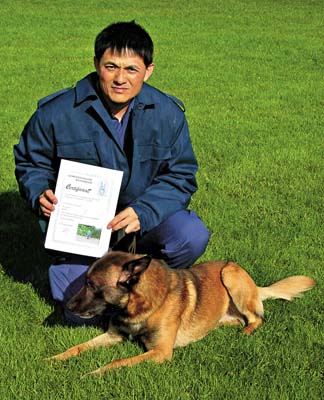
Sgt Mr Chan Wai-ki and Max pass the course - next stop, Hong Kong
"Currently, we acquire some Alsatian puppies from private kennels
to ensure that our in-house gene pool does not become too small, but most
of the dogs we use are actually bred in-house. Usually, at about six
months of age, they are fostered out to families for about 18 months
'family life' experience. They then return for operational training, which
lasts at least 15 weeks for a patrol dog. Unfortunately, the
'fail-to-pass' rate at the halfway point on that training can be as high
as 30% (it is up to 50% in some countries) and of those that do pass, few
can offer an active service life beyond seven or eight years. Factoring in
the unusable dogs and those that subsequently succumb to disease and
injury (not uncommon with pedigree animals), a working dog is an expensive
creature."
Max the Malinois
"The Dutch system appears to be much more efficient in time and
money," said Mr Ng, "simply because dog breeding and training is
almost a national obsession in that country. For more than 100 years there
has been a regulated breeding and training programme that now boasts of
more than 500 training and certification centres throughout the country.
The Royal Dutch Police Dog Association (KNPV) awards certificates, Class 1
and Class 2, to dogs that meet its extremely high-standards in health,
agility, temperament, obedience, search, and arrest.
"The favoured dog is the Malinois - technically a
cross-breed," said Mr Ng. "The Malinois gene pool has been
widened over many decades through cross-breeding with Dutch Shepherds,
German Shepherds, Great Danes, etc. It is usually only of medium size, and
both colouring and configuration vary far more widely than would be
permitted for American Kennel Club pedigrees. It is relatively long-lived
(13+ years), usually very healthy, resistant to disease and injury, agile,
and spirited. It is also extremely intelligent, affable, loyal, obedient,
and easily trained.
"At about three years of age, a fully-mature, trained and
certified Malinois can be sold to the Police Force and other government
agencies using or offering canine services. All dogs in government service
must, by law, hold KNPV certification.
"While some owners keep the dog as a companion, a large number are
available to government agencies, and because this breed usually enjoys a
longer life-span, it can offer at least 10 years active service.
"The Dutch Police do not have to pay for the breeding programme
and for the basic training of anything up to twice as many puppies as they
can subsequently put to work,' said Mr Ng. "They pay only the market
rate for a mature, trained and certified Malinois and this is
significantly lower than the rate for pedigree Shepherds, Labradors and
Spaniels. They are also in plentiful supply. The only further training a
Malinois requires is for specialisation and familiarisation with the
assigned handler - no more than six weeks as opposed to at least 15
weeks."
OffBeat went into the exercise field with Mr Ng, Mr Chan and Police Dog
Max, a mature Malinois which, with half-a-dozen younger dogs, was recently
imported from the Netherlands. Max was indeed a playful, friendly dog and
would have been quite happy to have carried on kissing and cuddling
forever, but Mr Ng issued a quietly spoken command (in Dutch, for the
moment) and he immediately sat at attention beside him - completely
ignoring OffBeat.
Max then demonstrated his prowess at surmounting a 2m wall, and
patrolling attentively but not aggressively with his handler. The dog has
earned a good reputation for its confident, firm but non-aggressive stance
on crowd management duties, its dogged perseverance on search and pursuit
operations, and its ability to effect an arrest with the minimum of force.
"We have these dogs for evaluation purposes," explained Mr
Ng, "because we must be sure that they can adapt to the Hong Kong
climate and to local threats to canine health. If they can do that, I am
sure that they will make an unprecedented contribution to continuing Force
efforts to serve the community with pride and care."
"It was worth it," said Mr Ng. "Our Dutch
hosts could not have been more friendly and helpful. We learned so much
while we were there and now we are looking forward to putting it all to
practical use here in Hong Kong. We hope to be able to reduce the time and
cost of acquiring and training dogs, and increase the length of active
service for both patrol and sniffer dogs.
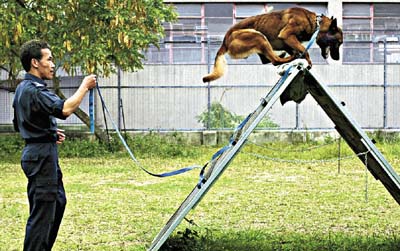 SIP Mr Mike Ng Kwok-wing and Max take some exercises