Marine dual training plan progressing well
Under the DTP, it will take only two years' sea-time for an officer to qualify for both the Marine Police Coxswain Certificate (MPCC) and the Marine Police Technical Certificate (MPTC).
In an interview with OffBeat, Assistant Force Training Officer Marine (Navigation & Seamanship) Mr George Tang Ying-kit explained: "In the past, marine training was divided into two streams - deck (MPCC) and engineering (MPTC). However, times have now changed, with launches becoming more advanced with onboard machinery and navigational equipment capable of operating in an automatic mode. At the same time, the educational level and capabilities of our officers have also improved a lot. So, now is the time to change our approach to training.
"Previously, Marine officers would move on to more specialised training in either deck or engineering streams after obtaining the Marine Police Efficiency Certificate (MPEC) and serving one year's sea-time. They would then need to serve a further two years' sea-time before they could be awarded either the MPCC or the MPTC.
"Officers who were assigned to a particular stream would have no opportunity to work in the other stream and this has operational drawbacks. For example, when there is a need to take over control of a vessel immediately during a stop and search operation, the type of training received by individual officers can hamper manpower deployment.
"Under the DTP, each dually trained and dually qualified officer will be capable of handling all such spontaneous incidents. It will allow for a more efficient and effective utilisation of human resources because the deployment of individual officers will no longer be constrained by their having received no training or qualification in one or the other of the two streams. Hence, the management will enjoy greater flexibility in their day-to-day deployment of human resources."
The DTP enables the Marine Region to adopt a versatile marine policing strategy, which focuses on a more flexible and efficient deployment of resources.
Beneficial to Participants
Not only is dual training beneficial to the management, but also to the individual officers.
Mr Tang said: "The programme will be conducive to enhancing the self-value of individual officers. After training, they will no longer be limited to working in either the deck stream or the engineering stream and this will enhance their competitiveness.
"Morale should be further enhanced as officers will have more training opportunities and enjoy a greater variety of job opportunities. What is more," he said, "the qualifications obtained under this programme can be translated into commercial licences."
Under the DTP, officers will be issued with a task book as soon as they pass the MPEC. The book includes information on both the deck and engineering aspects of their on-the-job training and this will encourage them to gain experience in those areas. It will also result in a reduction in the total amount of training time required for qualifications in both the MPCC and the MPTC.
"Moreover," said Mr Tang, "training will no longer be restricted to classroom teaching at the Marine Police Training School - it can take place anywhere. Supervisory officers at the sub-unit level can provide ample opportunities for frontline officers to accumulate more experience in both the deck and the engineering aspects of their daily work while staff at the divisional level will be able to monitor the progress of individual officers.
"The initial response to the DTP is encouraging and officers are anxious to take part in it," he said. "We understand that some officers may not be able to achieve the dual qualifications but they will still be fairly treated."
Vow to be All-round Cops
Marine East Division Woman Police Constable Ms Joanne Yam Tsz-yan and Marine South Division Police Constable Mr Lee Kin-man were among the first batch of officers signing-up for the DTP. Both had previously specialised in the deck stream and were eager to enrich their knowledge in the engineering aspects with a view to becoming 'all-rounders'.
Ms Yam said: "In the beginning, I encountered some difficulties in learning about the mechanics of operation and maintenance of engines. But, with the help of my instructors, I soon overcame the difficulties and doubled my efforts to achieve new skills.
"I love my work on the Police launch. In the past, I have taken a one-year private course in marine engineering and have all along developed a strong interest in this aspect. The programme is useful and can enhance my knowledge indeed," said Mr Lee.
Both of them believe that dual training for Marine officers is the right way forward. Ms Yam said, "After I obtain dual qualifications, I will be able to lend a hand to any of my colleagues in the engineering stream whenever it is necessary. It should also enhance my working ability and career prospects."
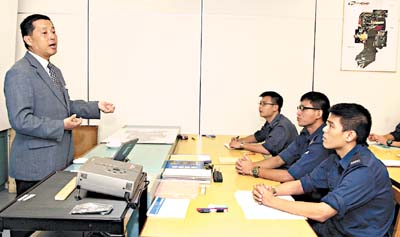 Assistant Force Training Officer Marine (Navigation & Seamanship) Mr George Tang Ying-kit explains the advantages of the 'Dual Training Programme' to attentive mariners
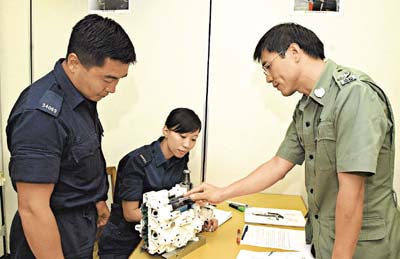 Marine Police Constable Mr Lee Kin-man (left) and Woman Police Constable Joanne Yam Tsz-yan under instruction