

Balances in Law Enforcement Series V-
Women in Policing
Male and female officers stand equal chance
Ms Chang sees herself as a "beneficiary" of the Force's policy on equal opportunities. "I'm lucky to be the first woman officer ever selected to attend a training course at the Royal College of Defence Studies in the UK. There are other examples of women officers being given greater exposure. For instance, a woman superintendent was posted to Interpol in 2004 and another woman superintendent was seconded to the Centrex Police College, UK, in 2006," she pointed out. Ms Chang has absolutely no doubt that women officers, if given opportunities, will be able to live up to the Force's expectations. The performance of the Tango Company during the Hong Kong Ministerial Conference is a case in point demonstrating women officers' ability of working on the frontline, she said.
"Women officers are capable of doing a good job on the frontline. Perhaps, their feminine touch, patience, sensitivity, communication skills and attentiveness are advantages over male officers when dealing with general citizens in situations like crowd management operations. These attributes can help ease tension at the scene, or even stave off a highly charged situation. Another recent case in point concerns a woman chief inspector of Kowloon West, who successfully persuaded a distressed constable to put his gun down after he threatened to commit suicide. Male and female officers are complementing each other," she added.
Just like the Force policy on equal opportunities, Ms Chang said women officers have also made great strides in their personal development.
"Nowadays, women officers have high academic qualifications. They went through a very stringent selection process before joining the Force. Generally speaking, the selected female officers are mature and independent, and enjoy challenging work. These qualities enable them to get along well with male officers, and adapt themselves to working in a man's domain. There isn't any gap between male and female officers in the office," she said.
To Ms Chang, what matters most for women officers working in a male-dominated environment is proving they have the ability to get jobs done. In her almost 28 years' service in the Force, she steadfastly adheres to this motto.
She has worked in different posts in different Formations, including UB, CID, Training Wing, Personnel Wing and Service Quality Wing. She has also worked on attachment to the Corruption Prevention Department of ICAC and a unit in the Chief Secretary's Office, dealing with greater integration between Hong Kong and Guangdong.
Whilst she enjoyed the exposure to non-police work during these attachments, Ms Chang finds her frontline work as a young CID officer in the 80's "most unforgettable".
"CID work has given me a lot of satisfaction because I came into contact with a lot of people. I helped them direct, and could see the results of my effort in a more tangible form. The other reasons for my satisfaction were the team spirit and close working relations among the officers in the units I had worked," she explained.
Officers - an important asset
As a senior officer, Ms Chang regards human resources as an important asset for the management at the work place. Therefore, she strives to build up a "personalised relationship" with her staff by keeping an open mind about their views, feelings and suggestions. She pointed out that after she had conducted annual staff appraisal interviews, she always asked officers how she fared as a supervisor or commander in their eyes. "I surely have blind spots, so I value feedback from my subordinates to help me stay balanced and objective on various matters. For me two-way communication is very important!" she remarked.
Challenges for women police officers
Ms Chang believes that the greatest challenge for women police officers nowadays is striking a correct balance between their work and family. "It goes without saying that women play an important role in families. This is especially true for children's upbringing," Ms Chang noted. Therefore, Ms Chang devotes as much attention as possible to her children's development. She focused a lot on her children's academic performance when they were in primary school. As they reached adolescence, she paid more attention to their character building, independence and other personal developments.
To strike a good balance between work and family, Ms Chang encourages women officers to openly negotiate with their spouses for the joint responsibility of looking after family matters and to secure their support and co-operation.
Whilst her great emotional attachment to family might serve as an inspiration for other police families, Ms Chang ranked the importance of health above family and career. Therefore, she concluded the interview with a piece of advice for officers, in particular female ones. "Take good care of your health. Do more exercises, take more rest and acquire good stress management skills!" she advised.
Comments by Psychological Services Group (PSG)
The interview with Ms Chang showed us the challenges faced by and transformation of women police officers in the past few decades. As mentioned by Ms Chang, women officers need to show that they can meet all the demands from their police duties and that they are as competent as their male counterparts in order to gain recognition in a setting where most officers are male. However, male officers will normally only compare themselves with other male colleagues when they want to prove their abilities; seldom do they set some distinct female counterparts as their competitors.
Like other senior women police officers, Ms Chang's ability and competence are beyond doubt. From the perspectives of psychology and human resources management, there are three major factors contributing to her success.
The first factor is her confidence in her own ability, which made her break through the traditional stereotypes of females and actively devote herself to police duties. A psychological research has pointed out that people who believe in their own ability would gain more satisfaction from their work, contributing to a better performance.
Secondly, she has fully utilized her strength in good communication and relationship-building skills at work; and with her frank and open character, she has built a happy working relationship with her colleagues. As the leader of her team, she does not just show care to her subordinates, but also actively listens to their comments and has regular self-reflection. She has shown us the essential elements of effective leadership.
Last but not least, she has wisely set "self-care" as an important goal in life. She herself achieves it by having regular exercises, adequate rest and stress relief and at the same time, also encourages others to do the same. This is because she understands that only with good physical and mental health, one can then maximise his or her potential and enjoy life and work.
Seek advice and help from PSG: 2866-6206 (5th floor, 111 Leighton Road, Causeway Bay). PEN: psg@police.gov.hk
(All cases will be kept in strict confidence.)
The Force has made great strides in offering equal opportunities to both male and female officers, but our female colleagues have to equip themselves so that they can assume more and heavier responsibilities when an opportunity comes, said Kowloon West Deputy Regional Commander Chang Mo-see during an interview with Psychological Services Group and Staff Relations Group.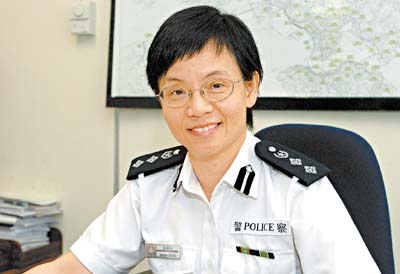 Ms Chang values "personalised relationship" with her staff