A keen police artefacts collector
An old yellowing receipt issued by the Mainland's Public Security Bureau (PSB) after the founding of the People's Republic of China, has special meaning to Detective Station Sergeant Lam Kin-keung. It reminds him of his relative who voluntarily handed in to PSB a pistol used for self-defence. The receipt was not only the first police artefact he had collected, but also aroused his interest in digging deeper into the history of Chinese police forces ever since.
Since he started collecting police artefacts such as badges as early as 20 years ago, he has amassed over 600 various items, dating from late Ching Dynasty to the establishment of PRC. These artefacts, he said, not only have witnessed the changes of history, but also have stories to tell about the developments of policing on the Mainland.
Being a policeman himself, DSSGT Lam is fond of all kinds of police artefacts.
During an interview with OffBeat, DSSGT Lam of Hong Kong Island Regional Crime Unit eagerly introduced part of his collection. Showing a transport registration licence issued by the Force in 1945, he said that in those days, it was police's job to issue transport registration licences. What interests him most is the fact that the licence did not bear the police insignia but the crown of King George V. He explained: "As Hong Kong was a British colony at that time, most government documents bore the crown as insignia."
Most of DSSGT Lam's collection items, such as different appointment letters, graduation certificates, commendation letters and badges, etc., date back to the Nationalist Government and the time shortly after the founding of PRC. Amongst them, what he likes most is an appointment letter signed in 1922 by Zhu De, the Director of the Public Security Department of the Yunnan Province.
Why is it so special? "Zhu De was called the father of the Red Army who later became the Commander-in-Chief of the People's Liberation Army," he explained. "Besides Mao Zedong, who was the Chairman of the Chinese Communist Party, Zhu occupied the second highest post in the party when PRC was founded. He had not yet joined the Communist Party when he issued the appointment letter. Objects related to Zhu before he joined the revolutionaries are hard to come by in the market, so the appointment letter is particularly valuable."
For DSSGT Lam, finding rare artefacts is a pleasant experience, but their historic backgrounds have also brought him added satisfaction. He said: "Some artefacts, like badges, aren't marked with years. To find out their history or authenticity, you've to do a lot of research. Take Zhu De's appointment letter as an example, to ascertain its genuineness, I've to check whether Zhu's title tally with the year. There are also other ways to find out its authenticity, say from the paper's texture and colour."
Enjoyable process
To know more about an artefact's background, DSSGT Lam uses every possible means, such as browsing the Internet, or through chat room to get help from other police artefacts lovers. He even goes to libraries on the Mainland. Sometimes, it might take him as long as four to five months to find out what he wants. However, he does not see this as a difficult job. He said: "I find the process of finding information most enjoyable. Just like investigating into cases, we've to unearth fact from various clues. The feeling is beyond description when information is found."
DSSGT Lam's collection items have now filled up his study room. "I'm nurturing my son's interest in police history so as to groom him to be my successor," he said with a grin.
To let people know more about the history of the Chinese police, DSSGT Lam, together with some police artefacts lovers, has established a Police Historic Artefacts Collectors Society. The society's first public function was an exhibition of police artefacts held in June this year in collaboration with Hubei University. They are also planning to stage another exhibition in October in Hong Kong. The Society now has around 20 members comprising personnel from the Force, PSB on the Mainland, police artefacts collectors and university researchers on police history.
Being a long-time collector, SSGT Lam's biggest wish is to establish his own private museum to arouse more interest in police history.
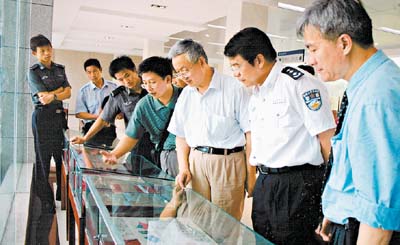 The Police Historic Artefacts Collectors Society's joint exhibition in Hubei