Force integrity management initiatives publicised in Macao
The Force has been very much in the vanguard of promoting integrity and fighting corruption within the law enforcement agencies in the Region and, in recognition of these efforts, the Complaints and Internal Investigations Branch (C&IIB) Chief Superintendent Fan Sik-ming and C&IIB Senior Superintendent Chung Siu-yeung recently gave a presentation on managing police integrity at a seminar in Macao at the invitation of the Macao SAR Government.
Organised by Macao's Commission Against Corruption and the Office of Security, the seminar was held at the World Trade Centre in Macao on July 13 and was attended by about 100 senior law enforcement officers there. The Macao SAR Government's Secretary for Security, Mr Cheong Kuoc Va, delivered the opening address.
Speaking at the seminar, both Mr Fan and Mr Chung took the opportunity to elaborate on the Force's integrity management initiatives, which, they pointed out, contributed to a steady and continual decline in the number of corruption complaints against police officers in recent years.
They cited figures to show that in 2006 the numbers of officers charged by the ICAC for Prevention of Bribery Ordinance offences; misconduct and malpractice complaints against police officers; disciplinary cases involving police; and officers with unmanageable debts, were all at their lowest levels in years. On the other hand, public confidence in the Force was at its highest.
Their presentations also covered the Force's stance and procedures for tackling the problem of undesirable association. A short film from the Living the Values V workshops, which highlighted the sweetening process and conflict of interest situations in the context of undesirable association, was shown at the seminar to brief the audience on how the Force reminded its staff of the pitfalls of associating with undesirable personnel.
Impressive figures
Talking about the seminar on his return from Macao, Mr Fan enthused: "These figures are indeed impressive and we will be striving to ensure they are kept at these low levels. We, as a police force, have been able to fight corruption because of Hong Kong's sound constitutional basis; the support and example of the senior Force management; and the development of clear and evolving anti-corruption strategies. However, none of this will work without the support of our Force members and I encourage everyone to join in the fight against police involvement in corruption, criminal activity and misconduct in all forms. Blatantly corrupt acts are very rare nowadays, but officers must be mindful of the pitfalls of undesirable association and strive to avoid conflict of interest situations."
Four-pronged approach
Speaking of his presentation, Mr Chung said: "I was able to introduce the four-pronged approach of the 2006 Force Anti-Corruption Strategy at the seminar. This approach focuses on responsibility, education, prevention, deterrence and review, and leadership in order to achieve our goal of enhancing the level of integrity within the Force and, in so doing, reducing complaints of corruption and misconduct. Our presentation was well received and I hope it has provided some ideas for other law enforcement agencies to consider when they pursue their own anti-corruption initiatives."
The seminar also saw presentations by representatives of the ICAC and Macao's Commission Against Corruption. Thus it also afforded Mr Fan and Mr Chung the opportunity to meet other officials dedicated to fighting corruption in the Region, including Ms Tou Wai Fong, Deputy Commissioner of Macao's Commission Against Corruption and Director of Ombudsman Bureau.
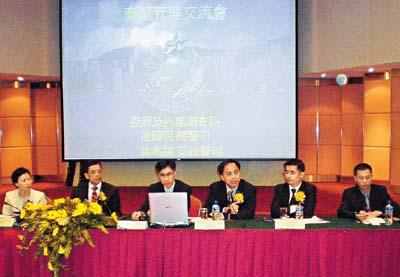 C&IIB's presentations cover many aspects of the Force's integrity management initiatives