Community policing in full steam in KWTDIST
Kwai Tsing District (KWTDIST) is stepping up implementation of a scheme on community policing in a bid to fight crime, maintain social order, and boost public confidence in the Force through a police-community partnership.
KWTDIST hopes, by means of the scheme, to engage citizens in issues affecting their own safety, and to encourage officers to think more creatively, make decisions independently and commit available resources to solving problems in the jobs they have been assigned with.
Speaking of the concept of community policing, KWTDIST Deputy Commander Raymond Siu Chak-yee pointed out that close co-operation between the police, in particular frontline officers, and the community helps establish and sustain mutual trust and enhance social cohesion. With trust, the community will be more co-operative and willing to come forward with information that helps intelligence-led investigations.
With community support, frontline officers will be able to do a job better and do it with more confidence.
Apart from the general public, Mr Siu continued, the "community" basically includes everyone, from community leaders to community organisers and activists, government officials, business community, the media and all other public and private agencies.
Security personnel are no doubt part of the community and play an important role in crime prevention. In a bid to forge a partnership, a mutually trusting relationship and two-way communication, KWTDIST has, with the assistance of the Regional Crime Prevention Office of New Territories South (RCPO NTS), held a total of four meetings at Kwai Chung Police Station with the management of the property management/security companies looking after different types of housing estate, as well as commercial and industrial buildings in the District.
Mr Siu chaired the meetings, and senior officers responsible for operations in Kwai Chung Division and Tsing Yi Division, Police Community Relations Officer and officers from RCPO NTS were also present to contribute their input.
He outlined the purposes of the meetings as follows:
* Seeking security companies' co-operation in encouraging their frontline security staff to make reports of any crime to the police immediately;
* Introducing the "Task Force Hotline" with an explanatory sticker;
* Introducing the new Security Personnel Permit (SPP) Holders Guideline for distribution to all frontline SPP holders;
* Introducing KWTDIST's "Police NoticeBoard" which is displayed in the lift lobby of each residential building to disseminate police or crime related information;
* Introducing the "Security Communication Network", which seeks to facilitate communication between the police and the property management/ security companies via electronic means, and
* Discussing the way forward for establishing a partnership between the police and security companies.
Speaking of the progress of the community-policing scheme, Mr Siu said that by October 24, a total of 51 housing estates and 29 commercial/industrial buildings and carparks had joined the "Security Communication Network", comprising 21 Public Housing Estates, 13 HOS Estates and 17 private housing estates.
Earlier, he attended the District Fight Crime Committee to introduce the community policing scheme and the related initiatives.
Security Communication Network
Mr Siu pointed out that the Security Communication Network aims at enhancing communication between the police and security companies and their frontline security staff through the use of technology (e-mail). Any information that the police wish to pass onto security companies, such as crime information of a particular interest, can be provided by simply "clicking a button". Vice versa, the companies can do the same if they have any queries or wish to send to the police any information their frontline security personnel have obtained from residents.
"This two-way communication is an important feature of community policing, with both parties (police and community) working in a proactive partnership. And close co-operation will help establish and sustain mutual trust," he said.
Task Force Hotline Sticker
Mr Siu further pointed out that the Task Force Hotline Sticker provides an additional channel for security personnel to make reports to the police whenever they come across any suspicious characters or circumstances, instead of first seeking instructions from their supervisors or dealing with suspects by themselves. Copies of the sticker are put up at security personnel's posts to ensure the hotline number is visible at all times, encouraging them to contact the police whenever it is necessary. The sticker also emphasises that they should call 999 whenever they require urgent police assistance.
Police NoticeBoard
Most public housing estates in Kwai Tsing District have agreed to set aside a notice board at the lift lobby of each of their residential buildings for the police to bring information on crime prevention to residents and frontline security personnel. The board aims to attract the attention of residents and serves as a way to promote communication between the police and residents, he added.
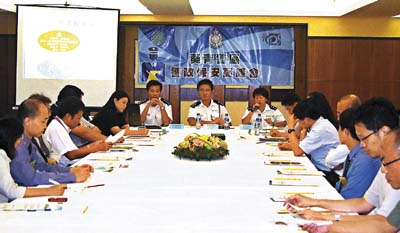 Kwai Tsing District's "Summit on Security"