EU KE combines Small-Scale Exercises
with Knowledge Management
The primary duty of the Emergency Unit (EU) is to provide Regions with a professional, well-trained and well-equipped team, able to tackle and respond to cases such as emergency service requests, sudden major incidents, and serious and violent crimes.
In order to live up to the increasing expectations of the community towards the Force, EU Kowloon East (KE) needs to ensure the quality performance by its members, delivered with appropriate professional sensitivity. It is crucial that officers receive high-quality training and that EU KE implements strong support measures, which, by doing so, can also tie in with the Force Strategic Directions, in particular "Enhancing Personal and Professional Qualities of Force Members" and "Supporting Frontline Units".
After reviewing training and exercises, EU KE introduced, in April, a series of new small-scale exercises and recorded the entire process for evaluation purposes. Each exercise lasts no more than 15 minutes.
Subsequently EU KE Company Commander Christopher Wilson applied his knowledge management skills to acquire, store and sort the dominant (i.e. Force Procedures, laws, tactics and techniques) and recessive (i.e. experience, sensitivity, and ability to cope with contingencies) policing knowledge through these exercises for future sharing and review.
Relevant principles of the small-scale exercises are as follows:
Selection of Suitable Material for
Small-Scale Exercises (relevant to daily cases faced by EU)
a. 15 emergency case categories defining the core duties of EU KE;
b. Violent cases often handled by EU KE;
c. Previous cases of special interest dealt with by EU KE;
d. Analysis of complaint cases against EU KE; and
e. Analysis of crime trends for Kowloon East Region (recent rampant cases).
Mode of Small-Scale Exercises
a. Conduct small-scale exercises every week;
b. Conduct sudden exercises on EU members by random selection; and
c. Conduct tests on EU members in an unexpected manner.
Store and Sort Knowledge acquired from
Exercises
a. Store the scenarios for small-scale exercises;
b. Assess and sort relevant information after the exercises; and
c. Record the whole process on video and immediately review upon completion of the exercise.
Experience Sharing
a. Use the videos recorded during the small-scale exercises on training days;
b. Encourage all EU members to participate in the discussion after the exercise by way of brainstorming;
c. Gain a better understanding of law enforcement through experience sharing and collective reviewing of the exercises; and
d. Broaden the mind and improve the responses and sensitivities to law enforcement and better understand the concomitant interaction with the community.
To sum up, the objectives of the small-scale exercises are:
1. To provide strong and practical training;
2. To pass on relevant dominant and recessive knowledge through knowledge management;
3. To assess members' professional abilities and sensitivities to law enforcement through small-scale exercises; and
4. To draw on the collective wisdom and experience and to raise team spirit through sharing and discussion.
The ultimate goal is to arouse the interest of the whole Unit to actively participate in the exercises in a pressure-free environment, so that they can provide quality and up-to-date service to the community through their improved personal qualities.
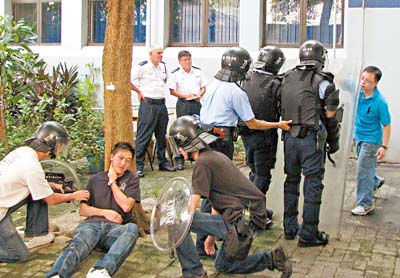 The
small-scale
exercise aims at improving officers' professional qualities
and supporting those working on the frontline
The
small-scale
exercise aims at improving officers' professional qualities
and supporting those working on the frontline