Overall law and order situation remained stable in 2010
The overall law and order situation in Hong Kong remained stable in 2010 with a drop of 2.1 percent in the overall crime, Commissioner Tsang Wai-hung said when he reviewed the crime situation at a press conference on January 26.

Commissioner
Tsang Wai-hung briefs chairmen of District Fight Crime Committees on
the law and order situation in 2010
The detection rate was 42.8 percent, a decrease of 2.8 percent compared with the preceding year.
A total of 13 546 cases of violent crime were recorded last year, a drop of 4.6 percent compared with 14 193 cases in 2009.
Noting that most categories of crimes recorded a fall, Mr Tsang said the crimes, which were on the rise, were deception (up 10.2 percent), pickpocketing (up 29.4 percent), miscellaneous theft (up 2.2 percent) and indecent assault (up 9.9 percent).
Deception cases
"A total of 5 652 cases of deception were registered in 2010, an increase of 522 cases or 10.2 percent compared with the previous year.
"Increase was seen in common deception cases such as telephone deception and street deception. While there was a rise of 523 cases of telephone deception compared with 2009, a significant growth was registered particularly in the fourth quarter of 2010, which was attributable to a new modus operandi of 'Guess who I am' " he added.
Mr Tsang went on to say that despite the rise in telephone deception in 2010, the loss involved saw a decrease by $3.77 million or 12.8 percent, with the amount involved in the majority of "Guess who I am" cases being less than $30 000. Moreover, over 70 percent of swindlers failed in their criminal attempts.
Pickpocketing and miscellaneous theft
A total of 1 400 pickpocketing cases were recorded in 2010, an increase of 318 cases or 29.4 percent compared with 2009. Police will continue deploying experienced officers to black spots of the crime. Anti-pickpocketing publicity will also be enhanced to remind the public and visitors to remain vigilant and to take care of their personal belongings, especially in crowded areas.
Miscellaneous theft increased by 418 cases to 19 058 cases in 2010, a rise of 2.2 percent compared with the previous year. The increase was due to the rise in metal theft and theft related to cases in which ATM users forgot to collect their withdrawals from the ATM.
Sexual offences
As regard indecent assault, 1 448 cases were recorded in 2010, representing a rise of 130 cases or 9.9 percent compared with the previous year. About 19.5 percent of those cases were related to public transport.
The Police will continue to tackle this crime and to enhance public awareness with publicity campaigns, especially in the vicinity of MTR platforms during peak hours.
Mr Tsang also pointed out those crimes such as serious drug offences (down 25 percent), shop theft (down 5.9 percent), serious assault (down 9.1 percent) and missing motor vehicles (down 13.9 percent) all recorded a decrease.
Drug offences
During the year, there were a total of 2 196 serious drug offences, a drop of 733 cases compared with the preceding year. A total of 2 953 persons were arrested, a decrease of 744 persons compared with 2009. The total number of students arrested was 128, also down by 106.
There were 1 870 cases involving psychotropic drugs, making up 85.2 percent of the overall serious drug cases. Cases involving ketamine accounted for the largest share of 63.9 percent of the cases involving psychotropic drugs.
"As the majority of local drug supplies are imported, we will continue to work closely with the Mainland and overseas anti-drug law enforcement agencies to intercept drugs at their origins, and strengthen joint enforcement actions with Customs and Excise Department.
"Internally, Narcotics Bureau will coordinate intelligence-led operations against drug trafficking. Particular attention will be paid to supply of dangerous drugs to the minors and minors being used in drug trafficking activities," Mr Tsang said.
The Commissioner also touched on homicide, robbery, domestic violence crimes and juvenile crimes.
Homicides and robberies
A total of 35 homicides were reported in 2010, a decrease of 12 cases compared with 2009. Thirty-two cases were detected, representing a detection rate of 91.4 percent.
The bulk of these cases was either domestic violence or related to relatives. In 24 of the detected cases, the culprits knew the victims.
"Homicide cases are serious and also our biggest concern. Police will deploy adequate resources and conduct thorough and multilateral investigations with a view to swiftly bringing offenders to justice," Mr Tsang stressed.
A total of 778 robbery cases were recorded in 2010, a 10.6 percent decrease compared with 2009 as well as the lowest figure since 1969.
Mr Tsang said most of the robberies were committed by lone culprits, indicating that they were acting individually. Police will continue to maintain strong police presence to combat robbery, particularly at high-risk locations.
Domestic violence and juvenile crimes
Criminal domestic violence cases recorded in 2010 totalled 2 157 cases, a drop of 216 cases or 9.1 percent compared with 2 373 cases in 2009. The cases were mostly triggered by disputes over money and relationship.
Turning to juvenile crimes, Mr Tsang said 3 576 juveniles (aged 10 to 15) and 4 255 young persons (aged 16 to 20) were arrested for crimes in 2010, bringing the total number to 7 831 persons, a decrease of 859 or 9.9 percent compared with 2009.
"The crimes committed by them were mainly miscellaneous theft, shop theft, wounding or serious assaults and serious drug offences," he added.
Force
Operational Priorities
Mr Tsang also took the opportunity to introduce the Force's Operational Priorities for 2011, which are violent crime, triads, syndicated and organised crime, dangerous drugs, quick cash crime and public safety, including road safety and terrorism.
Speaking about violent crime and quick cash crime, Mr Tsang said Police would maintain a strong police presence and carry out intelligence-led operations targeting criminals and street gangs.
"The Force will also continue to target triads and syndicated and organised crime activities at local, cross-boundary and international levels," he noted.
To combat dangerous drug offences, Mr Tsang continued, Police would continue to co-operate with other law enforcement agencies to interdict illicit drug flow into Hong Kong. A multi-agency and community-based approach would be adopted to promote public awareness and prevent psychotropic drug abuse. In addition, the Force would continue with professional risk assessments and policing of public order events to ensure public order and safety. More efforts would be made to deter drink driving, drug driving, speeding and illegal road racing, to monitor the trend of terrorism and to maintain a high-level of counter-terrorism readiness with regular training and multi-agency exercises.
Conclusion
"In the coming year, Police will continue with its quality service orientation. We will maintain high visibility, high profile policing for robust and immediate emergency and tactical response. We will also maintain community partnership and focus on professional ethics," Mr Tsang concluded.
Also attending the press conference were Deputy Commissioner (Management) Lee Ka-chiu and Deputy Commissioner (Operations) Tang Kam-moon.
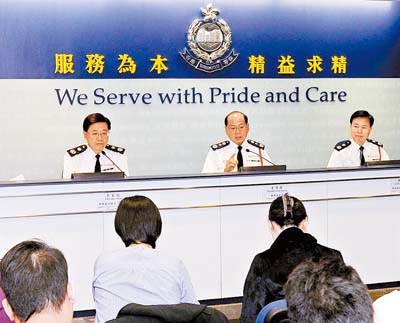 Mr
Tsang, Deputy Commissioner (Management) Lee Ka-chiu (left) and Deputy
Commissioner (Operations) Tang Kam-moon at the press conference
Mr
Tsang, Deputy Commissioner (Management) Lee Ka-chiu (left) and Deputy
Commissioner (Operations) Tang Kam-moon at the press conference