Social Responsibility Series (4)
Comparision of approaches to social responsibility
0 Photo
In this article, we present the approaches to implement and promote social responsibility taken up by the Force in contrast to the concepts, methods and the approaches adopted by some leading private sector corporations.
Mapping Force Vision and Statement
To translate the concept of social responsibility into action, formulation of a strategic framework underpinned by a proposed working definition is necessary. This will provide a system to guide collective action to take social responsibility forward and enable Major Formations to determine and manage social responsibility initiatives according to their business objectives and operational priorities.
At the third meeting of the Force Working Group on the Promotion of Social Responsibility on January 12, members agreed to use the working definition of Force Social Responsibility listed in Article One. The definition includes the elements of the Force Vision and Statement of Common Purpose and Values. We see that the five guiding principles of social responsibility, namely, beyond legal obligations, stakeholder interests, ethical values and societal expectations, sustainability, and business integration can be mapped for the above-mentioned elements.
The Force Vision that Hong Kong remains one of the safest and most stable societies in the world is wholly compatible with the five guiding principles of social responsibility. By mapping the Force Vision vis-a-vis the five principles, albeit in the absence of an express policy on social responsibility, it is evident that the Force has adopted a corporate value approach in undertaking its social responsibility.
In Article Two, we mentioned that Microsoft and BodyShop had adopted this approach to determine their social responsibility priorities. Nevertheless, an eclectic approach comprising the elements of specialisation, risk management, stakeholder engagement and materiality are also suitable for the Force to determine its social responsibility priorities.
For instance, in our study of social responsibility, we noted that many Major Formations involve stakeholders, e.g. Non-government Organisations, in implementation of social responsibility activities, but have rarely invited them to contribute during policy development. As stakeholders may help map out key concerns and interests during the early stages of policy consideration, the Force may consider adopting a combined approach by aligning stakeholder engagement with corporate value to help determine social responsibility priorities.
Major Formation Initiatives
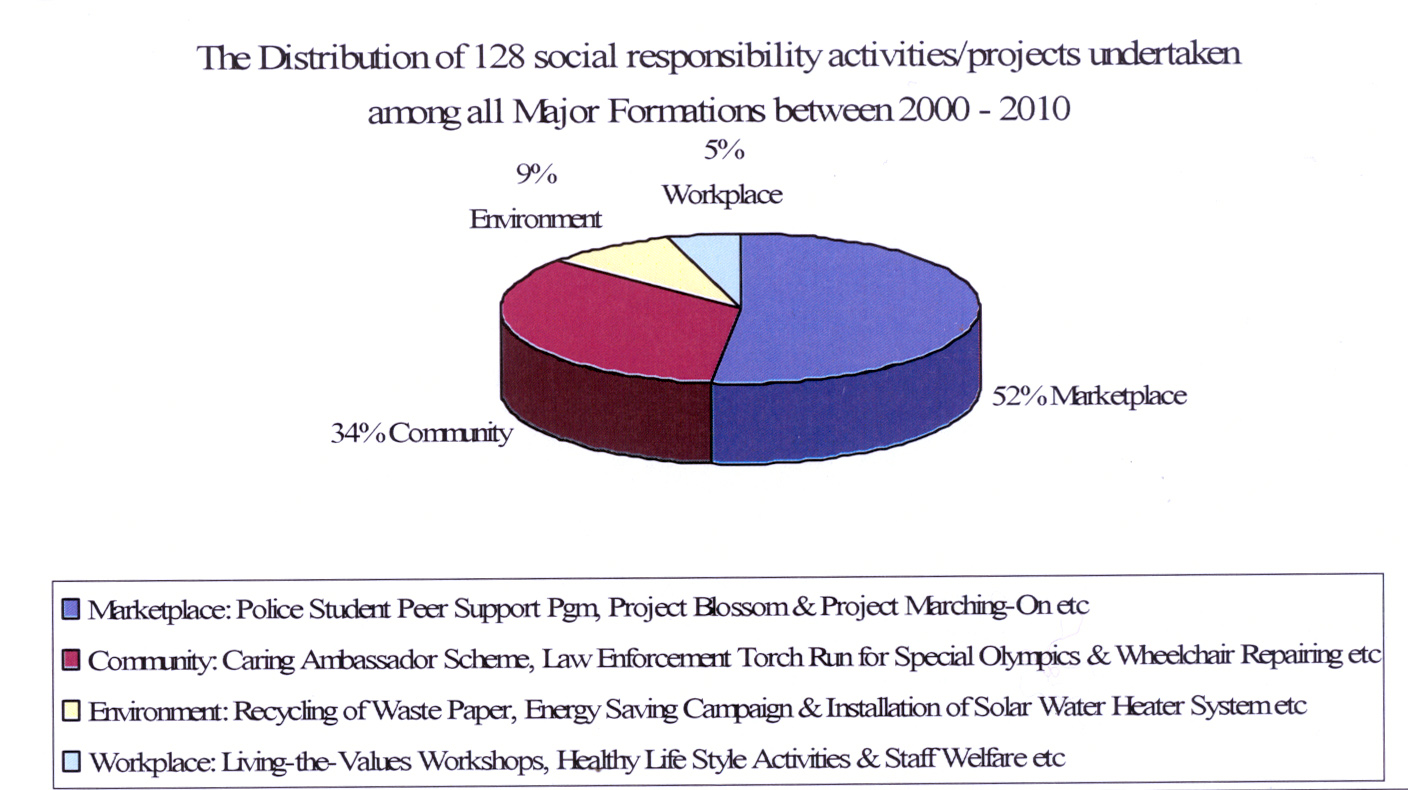
When the original research was conducted into social responsibility and SAP 2000 - 2010, 128 activities or projects undertaken among all Major Formations were identified, showing how social responsibility projects or activities within regions and policy wings cover all four pillars of Environment (9 percent), Community (34 percent), Marketplace (52%) and Workplace (5 percent). Although these initial results should only be taken as a broad reference, the proportion provides a conservative overview on the current situation, though a more recent research has indicated that well over 32 socially responsible activities will be ongoing throughout the Force in 2011.
Management
practices
Compared with social responsibility pioneers, whose approach to social responsibility followed a coordinated, organisation-wide programme of activities, the Force approach has involved activities steered and managed locally with individual Major Formations adopting different approaches. Without a policy framework to lead and drive collective action, it is natural to see such uneven distribution of emphasis and resources among Major Formations. Likewise, without a robust management system to guide and evaluate performance outcomes, a social responsibility movement is hard to sustain, especially when initial enthusiasm and interest gradually fades out with time and staff turnover. This has led the Force to consider how we can introduce effective and feasible social responsibility management practices. This is why social responsibility is included in the SAP 2010-2012 to address this issue, such as implementing the concepts and the methods discussed in Article Three.