4 Photos
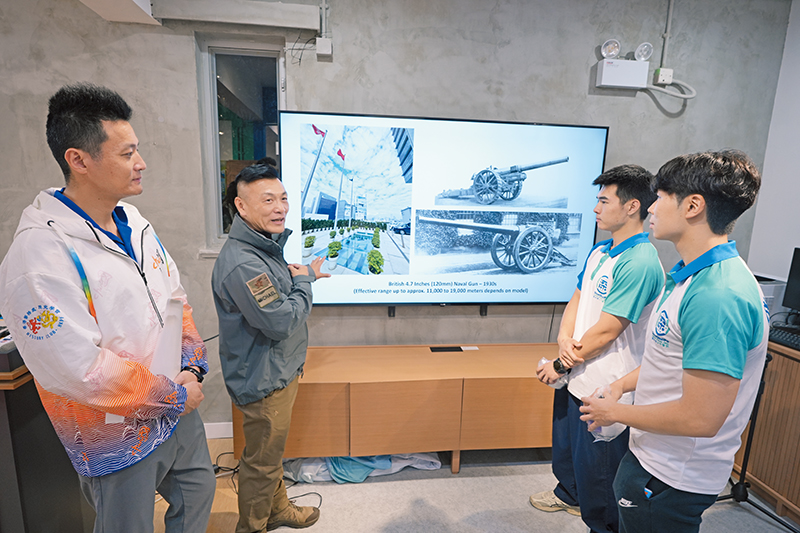
The Police History Club (PHC) organised a sharing session titled “The Historical Evolution of the Barrier Wall and Forts at the Hong Kong Police Headquarters (PHQ)” on February 13. Presented by Chairperson of the PHC Chan Wing and Executive Committee Member Li Lung‑chun, the activity attracted the participation of about 70 police officers, civilian members, retirees and Junior Police Call (JPC) members of Sham Shui Po District. Through reviewing the construction and transformation of the barrier wall and forts at the PHQ, the activity showcased Hong Kong’s town planning development while preserving this unique aspect of the Force’s history. Officers and JPC members expressed that the sharing session had enhanced their understanding of the history of the Force.
Chan Wing said officers often visited the PHQ for various duties and might have noticed some distinctive architectural features around, such as the stone barrier wall and several forts near Caine House.
Since the 1950s, the Force had built the stone barrier wall and a number of defence forts at the PHQ on Arsenal Street during different periods in response to defence needs. In the 1970s, to consolidate resources and enhance functions, the Force reinforced the barrier wall and forts. Later, in the 1980s, some sections of the wall and forts were demolished one after another due to urban modernisation. These structures not only serve as tangible marks of the Force’s development, but also reflect the changes in the city’s urban planning and social structure.
Erecting of barrier wall and forts
In 1954, the Force constructed Caine House on Arsenal Street, replacing the post‑war Oriental Building on Connaught Road Central and becoming the new PHQ. In addition to erecting a barrier wall outside the building, the first to third forts were built at various locations along the wall. In 1957, three years after the completion of these forts, the Force added a barrier wall along Hennessy Road, with the fourth and fifth forts built at the eastern and western corners of the wall, while constructing the married quarters on Arsenal Street.
Strengthening of defence
In 1971, the Force constructed May House on a vacant military site between Caine House and the married quarters, and connected the entire area with a barrier wall, establishing the boundary of the present‑day PHQ compound. Between 1971 and 1973, the Force built a barrier wall outside May House and added the sixth to ninth forts along the wall. These four forts were equipped with two ground‑level gun loops to enhance defence capability. This design feature can still be seen today on the ninth fort on the barrier wall at Harcourt Road.
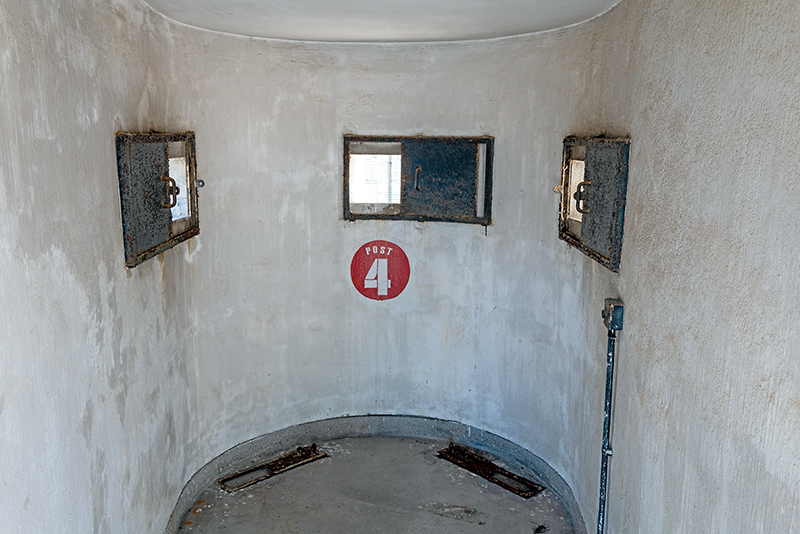
Moreover, there is another fort which still exists within the PHQ, distinguished by its unique architectural design among the Force’s buildings, and is not well-known given its relatively inconspicuous location. In 1972, the Force realised during the construction of the Arsenal Street flyover that the section near Harcourt Road was above the barrier wall outside Caine House, and therefore added the tenth fort on the second‑floor rooftop of the Annex Block of Caine House. There are a total of seven gun loops on the walls and floor of the fort, with a distinctive elongated curved structure providing an all‑round vantage point over Arsenal Street, the flyover, and Gloucester Road, further enhancing the defence capability of the PHQ.
Urban transformation
With urban development and the redevelopment of the PHQ, some sections of the barrier wall and several forts were demolished one after another due to road and construction works. Fortunately, the second, ninth and tenth forts, part of the barrier wall built in 1954 next to the pavement along Harcourt Road and Arsenal Street outside Caine House, and another section of the barrier wall constructed between 1971 and 1972 which runs from the entrance of the PHQ at Harcourt Garden to Hennessy Road have been preserved. In addition, the rock pieces from a section of the barrier wall built in 1954 which was demolished for the construction of the Harcourt Road vehicle entrance of the PHQ were reused and laid on the outside wall of Arsenal House facing Harcourt Garden, serving both decorative and conservation purposes.