Task force wages
war on porn sellers in Mongkok
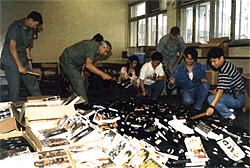
Porn busters: Mongkok District officers
destroying obscene material |
POLICE officers in Mongkok District last week destroyed about 1,500 pornographic VCDs and video tapes as part of an ongoing crackdown on obscene materials
by a special Task Force Support Sub-unit who have made 400 shop raids in
the district in under a year.
"These video tapes and VCDs were seized in two operations in the Ho
King and Sino Commercial Centres. Of them, 697 items are VCDs and 787 items
are video tapes," said Chan Wah-shing, CIP Ops II MKDIST.
"Most of the VCDs we smashed are imports, while the video tapes most
likely were copied in Hong Kong. Each VCD costs the retailer about $10 to
$20, while the consumer price ranges from $80 to $250 each."
Police have listed 26 shops in Mongkok selling pornography. Most of them
are in the shopping malls at Argyle Street, Fa Yuen Street and Sai Yeung
Choi Street.
Said Chan Wah-shing: "Recently we raided a shop producing video tapes
from VCDs at the request of customers. We also found that some shops selling
pornography do their business under the guise of a video rental club. Members
of the club exchange old video tapes for new ones."
Task Force Sub-unit Inspector Ian Bamber said last month they swooped down
on 37 Mongkok porn sellers. Using the control buy method with a search warrant,
shopkeepers are usually charged with possession of an obscene article for
the purpose of publication, publishing an obscene article and the display
of indecent matter.
The prosecution rate is very high and those who are convicted are fined.
"The aim of the seizures," Inspector Bamber said, "is to
let these shops trying to sell obscene materials know that it will not be
tolerated - and to close down. In fact, many of them have already gone."

A cut above the rest
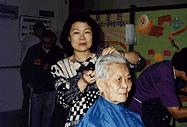
Auxy Ho Yuen-wan gives one of her elderly friends a free haircut.
Conversation no extra charge |
Auxy Woman Station Sergeant Ho Yuen-wan, an insurance company manager,
joined the Auxiliary Police Force in 1973 to serve the community. But her
helping those in need doesn't stop there.
In 1993 she was given the New Psychiatric Rehabilitation Association's Most
Outstanding Volunteer Worker award. Other awards for her community work have followed.
It all began seven years ago when while on beat patrol Ho Yuen-wan was touched
by the plight of many of the elderly citizens on Public Assistance who passed
their time in Leung King Park. She wanted to lend a helping hand, but didn't
know how to go about it. Not long afterwards, a friend invited her to participate
in some volunteer work in Leung King Estate.
Ho began her community work by learning to cut hair for seniors of the Estate
and the area. Nowadays she regularly cuts hair in three organisations for
the elderly as well as at a rehabilitation agency in Tuen Mun District.
The Auxy female barber is also active with other volunteer agencies who
take the elderly on local tours of the city; provide home visits to help
with daily housework and arrange medical check-ups and trips to the doctor.
"The biggest pleasure comes from the smiling faces of the elderly that
I help out. Their thanks is uplifting and makes you forget about day-to-day
weariness," says the Auxy Woman Station Sergeant, who urges more people
to get involved in volunteer work by using leisure time to help those in
need.
Ho Yuen-wan said being an Auxy is extremely rewarding. "Where else
can you serve the community, learn new work skills, enhance interpersonal
abilities and gain a better understanding of society?" she asked.
"But without the support and encouragement of my family, I could never
have found the time nor the energy to work for the Auxies and the community."
Police Museum - History in the making
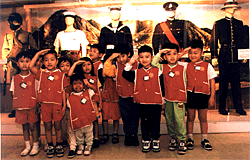
A group of young visitors pause in front of the current display
of uniforms at the Police Museum |
"The forerunner of the Police Museum was the Police
Historical Records Committee formed in 1964 which collected a significant
number of artifacts relating to the history of the Force and proposed the
foundation of a museum to display them.
"Originally housed in Police Headquarters, the Police Museum was started
in a limited form in 1976 and later moved to Tai Sang Commercial Building
in Wan Chai, then in 1988, moved to its present site in the former Wan Chai
Gap Police Station at 27 Coombe Road, mid-levels." said the
Force Curator Wong Nai-kwan.
"The Museum has four galleries and a total floor area of 570 square
metres in which over 600 exhibits are displayed," Wong said.
The Orientation Gallery describes the general history of the Force through
historical photographs, archives, uniforms, equipment, firearms and other
artifacts. Significant exhibits include the head of the "Sheung Shui
Tiger" which was shot in 1915 after killing a policeman, memorabilia
from the widow of former Commissioner of Police Duncan MacIntosh, and examples
of counterfeit banknotes.
Narcotics Gallery highlights the history of narcotic use in Hong Kong through
the display of replica drugs, drug smoking and trafficking paraphernalia
and an example of a heroin manufacturing laboratory.
Triad Societies Gallery features the history of local Triad Societies, the
scope of their activities and the beliefs and rituals that have been known
to be practiced by members. The Current Exhibition Gallery is thematic with
displays that are changed from time to time. The current display is on Police
Uniforms.
"The uniforms we display in the gallery are from the early 20th century
to 1997, including the uniforms of a Chinese police constable and an Indian
police constable from the early days of Hong Kong. We also make use of the
corridor leading to the galleries to display uniforms worn by higher ranking
officers such as the Assistant Commissioner of Police," said Wong.
"We are now collecting the whole range of uniforms worn by Hong Kong
Police in recent years. It's difficult to find those from the past
20 to 30 years because they are not old enough to be treasured by officers.
We would be grateful for donations of uniforms from this period - or
to borrow them if need be - in order to have a full collection of uniforms
of the era. Indeed, the short pants and S-shaped buckle worn by male police
constables two decades ago are very difficult to find.
"We also welcome donated items from colleagues that record their policing
work, be it a document, picture, plaque or anything of historical value."
The Police Museum today is routinely given a spare set of new uniforms for
its collection. "The officers in service today are really fit. The
average waist-size of pants is only 28 inches. The Museum display models
have 30-inch waists."
Mr Wong said the Museum welcomes on average 8,000 to 9,000 visitors a month:
"Summer is the peak season, we are fully booked between 12 July and
26 August by visitors touring in groups.
"The highest one-day record was 947 people last November. Apart from
viewing exhibits, visitors want to buy souvenirs with the police insignia
and crown. The most popular item is a helmet-shaped pencil sharpener.
"We also issue books and postcards that introduce the Force and the
exhibits. Asia's Finest Marches On by Kevin Sinclair and Nelson Ng will
soon be available here."
The Police Museum has applied to move to the old Marine Police Headquarters
in Tsim Sha Tsui. There the exhibition site will be bigger and more accessible
than the current one. |